Monday, March 26, 2018

John Bolton Isn’t Dangerous. The World IS. Obama appeased the tyrants and look where that got us.

s.John Bolton Isn’t Dangerous. The World IS

Former U.N. Ambassador John Bolton speaks at the Conservative Political Action Conference (CPAC) in Oxon Hill, Maryland, February 24, 2017. (Joshua Roberts/Reuters)
It’s time to give a hawk a chance.
Donald Trump has moved to replace H. R. McMaster with John Bolton, and the verdict is in. Americans should be “terrified.” Or perhaps “horrified.” The New York Times editorial board declares, in no uncertain terms, “Yes, John Bolton really is that dangerous.”
What’s going on? Has Donald Trump selected a crazed warmonger to be his national-security adviser? Is Bolton going to lead us down the path to foolish war? Far from it.
Bolton is not — as some in the media would have you believe — a mere flame-throwing Fox News “talking head.” He’s a former U.S. ambassador to the United Nations. He’s on the board of trustees of the National Review Institute. He’s a senior fellow at the American Enterprise Institute. He’s a conservative hawk, yes, but he’s squarely in the mainstream of conservative foreign-policy thought.
 
He’s not extreme. The reaction against him, however, is. Moreover, the reaction betrays a sad reality: The foreign-policy Left still hasn’t learned the lessons of the recent past.
To put it simply, all too many people view the challenge of North Korea and Iran something like this: There is a clearly safer path, including engagement, talks, and continued fidelity to the Iran deal; and there is a clearly more dangerous path — saber-rattling, increased sanctions, public advocacy for regime change. All right-thinking people should seek more engagement with North Korea. All right-thinking people should support the Iran deal.
The “clearly safer” argument always has a short-term advantage. When choosing between less risk of war and greater risk of war, there is a proper default preference for less risk and a presumption in favor of making immediate moves toward peace. When dealing with jihadist regimes like Iran’s or evil regimes like North Korea’s, however, the problem is that every single path is perilous.
Miscalculate in favor of war, and you risk an unnecessary bloodbath — one that America would win, but at immense cost in blood and treasure. Miscalculate in favor of peace, and you risk — God forbid — American cities in flames, a genocidal nuclear exchange in the Middle East, or (perhaps most likely) future military confrontations with aggressive and hostile foreign powers that we can’t truly win because of their own nuclear shield. Remember the words of Krishnaswamy Sundarji, former chief of staff of the Indian army: “One principal lesson of the Gulf War is that, if a state intends to fight the United States, it should avoid doing so until and unless it possesses nuclear weapons.”
World history is littered with both kinds of mistakes, and our recent histories with both Iran and North Korea indicate that bipartisan policies of engagement, negotiation, and forbearance have not, in fact, moderated either regime. Iran continues to export jihad, work to kill Americans, and ally with our Russian rival to engineer a bloodbath in Syria — even as the Iran “deal” fails to deliver on Obama’s dream of somehow bringing Iran into the community of nations. North Korea is well on its way to developing a nuclear first-strike capability that threatens the mainland United States.
Much of the American intelligentsia lives in a world where the “hawks” — those who supported the Iraq War — are discredited, while the “doves” — those who presided over American foreign policy while Syria burned, ISIS rose, and North Korea tested its nuclear weapons — are not. Yet didn’t Barack Obama himself have to turn hawkish by the end of his second term? Didn’t he reinsert American ground troops in Iraq and put boots on the ground in Syria? Didn’t he keep American troops in Afghanistan during every single day of his presidency and expand the American military footprint in Africa? It turns out that American inaction helped destabilize the Middle East and dramatically elevated the jihadist threat.
Moreover, we should not exaggerate John Bolton’s aggression. To be a hawk isn’t to see war as a first resort. It’s to see war as a realistic option — an option that ideally makes diplomatic overtures more urgent and effective. As the most powerful nation on the face of the earth, we should not conduct our diplomacy as if we fear war more than our potential foes do.
Even one of the pieces that the New York Times cites to justify its alarm — Bolton’s 2017 Wall Street Journal article analyzing military options in North Korea — contains this key sentence: “The U.S. should obviously seek South Korea’s agreement (and Japan’s) before using force, but no foreign government, even a close ally, can veto an action to protect Americans from Kim Jong Un’s nuclear weapons.”
A quarter-century of American nonproliferation policy has failed.
This is a sensible statement, indicating both the desire for agreement with key allies and the necessity of national self-defense, and the Times fails to effectively grapple with the truth underlying Bolton’s essay — a quarter-century of American nonproliferation policy has failed.
I’m not arguing for a strike against North Korea. As I’ve written repeatedly, war with North Korea would risk loss of life on a staggering scale. And even if future developments force Bolton to urge a strike — and the president agrees — it’s imperative that the administration seek the approval of Congress before launching any new military action. It is, however, simply wrong to believe that engagement and appeasement don’t carry their own profound risks.
A nuclear-armed Iran is far more dangerous than John Bolton. A North Korea capable of incinerating American cities is far more dangerous than John Bolton. The question is how we prevent those truly “horrifying” risks. The foreign-policy debate is frequently between hawks and doves, and in the last administration, the doves repeatedly failed. It’s time to give a hawk a chance.

Palestinians Are Doing Pretty Well Under Israeli Rule

Actually, Palestinians Are Doing Pretty Well Under Israeli Rule

If you look at the data, life keeps improving in the Palestinian territories.
  
Correction, 3/20/18: The piece originally stated that at the end of the Six-Day War in 1967, "Israel took over the Palestinian territories." During the Six-Day War, the territories in question belonged to Jordan, not "Palestine." The piece has been updated accordingly.
* * *
Of the various complaints made against Israelis, the worst has been the charge that the country is committing genocide. To wit: Nobel laureate José Saramago not long ago claimed that “what is happening in Palestine is a crime we can put on the same plane as what happened at Auschwitz.” While not every critic of Israel takes this line, enough influential academics and journalists have made similar claims, so that world opinion now judges Israel to be scarcely better than North Korea.
But “genocide” isn’t merely a matter of opinion; it’s measurable. Massive empirical data about life in Israel and the Palestinian territories has been compiled by distinguished Israeli journalist Ben-Dror Yemini and his recently translated 2014 book Industry of Lies shows just how ludicrous the genocide charge is.
Begin with life expectancy. At the end of the Six-Day War in 1967, when Israel took over the territories from Jordan, the average Palestinian in the West Bank and Gaza expected to live just 49 years, according to a U.N. report. In 1975, Palestinian life expectancy rose to 56; by 1984, it climbed to 66. Yemini notes that this is “a rise of almost seventeen years in longevity within seventeen years of Israeli rule.” Since 1984, Palestinians have lived an average of 75 years. That’s not only higher than the global average, but longer than the life expectancy in many Arab and South American countries—and even in some European countries. Israeli Arabs, meanwhile, have the highest life expectancy in the Muslim world.
Infant mortality is another marker of genocide and happily it’s been declining in Palestinian life, having shown dramatic improvement since 1967. Also a happy statistic: the high birth and low death rates of Palestinians in Gaza put the territory near the top of the world in population growth. It is a strange kind of “genocide” that creates the conditions for a population of people to flourish.
But it isn’t just the Palestinian people who have flourished. Infrastructure has also meaningfully improved—most notably, Palestinian access to clean drinking water. Under Jordanian occupation, only 4 out of 708 Palestinian towns and villages in the West Bank had modern water supply systems and running water.
Five years after Israel took over, the network of fresh water sources grew by 50 percent and continued to expand: By 2004, 641 Palestinian communities—accounting for 96 percent of the population—had running water, even in seasons of low rainfall. True, Hamas’s reckless sewage management and over-pumping from Gaza’s aquifer are aggravating regional challenges; but pioneering Israeli conservation tactics and technologies (such as drip irrigation and desalination plants) offer hope for the whole area. “One of the driest countries on Earth now makes more freshwater than it needs,” cheeredScientific American.
With improvements in physical well-being have come advances in culture. Palestinian literacy is impressive indeed: an astonishing 91 percent adult literacy rate. That makes the Palestinians the most educated population in the Middle East and North Africa (MENA) region, according to a 2006 World Bank report.
Israeli Arabs are also doing quite well academically, especially Arab Christians—who outperform Jews in matriculation certificates. “Christian Arabs do better than the Israeli Jewish population at large,” Yemini writes. “If the charge of significant [anti-Arab] discrimination were true, it is hard to imagine such an outcome.”
And if voting with their feet is any indication, a majority of Israeli Arabs prefer to live in Israel rather than other countries, as suggested in various polls. Many even favor Israeli-ruled East Jerusalem over Palestinian citizenship in the territories.
But what about all the bloodshed? Isn’t the Israeli-Palestinian conflict among the worst the world has ever seen? You wouldn’t use a word like “genocide” if it wasn’t, would you? As Yemini underscores: This is a big “no.” Over the last 70 years, 5 million lives have been lost in wars across the Middle East and North Africa; the Israeli-Palestinian conflict accounts for less than one percent of the death toll.
And even the larger Arab-Israeli conflict is way down the list of the world’s most lethal wars. Consider one comparison: In the Algerian War, France killed more Muslims in eight years than all the people killed in the entire 100 years of the Arab-Israeli conflict. About ten times more. And during those eight years, the French killed far more Algerians—nearly 30 times more—than Israelis killed Palestinians since 1948. “Relative to population size,” Yemini says, “more Palestinians have died in traffic accidents than in violent clashes with Israel.”
Given the extensive media coverage of this minor conflict, you would think academics and journalists might provide the public with more of these relevant comparisons. But comparative analysis is rarely how they explore the Israeli-Palestinian dispute. Like advertisers selling a product, they single out and sensationalize. Professors such as Harvard’s Stephen Walt and University of Chicago’s John Mearsheimer admitted as much in their scorched-earth attack on the Jewish state: “Our focus will be primarily on Israeli behavior,” the professors confessed in The Israel Lobby, “and no attempt will be made to compare it with the actions of other states in the region or in other parts of the world.”
Virtually anything can be made to look ugly when you isolate it and put it under a microscope: People are people and they often behave in ugly ways. This fact is part of the human condition, and not unique to Israelis or Palestinians or anyone else. And if what you’re looking to confirm is your own biases, there will always be anecdata you can find to support your case.
Israelis and Palestinians certainly have imperfections. Their shared home isn’t yet the land of milk and honey, but nor is it the hellhole often depicted by intellectuals and the media. To understand this truth, all you have to do is look at the objective data.
Next time a commentator starts to catastrophize about Israel, cheer them up with truths of increasing Palestinian life expectancy, declining infant mortality, growing populations, improved water conditions, amazing literacy, comparatively low casualty rates, and much of the other good news in Yemini’s level-headed book.
Jonah Cohen is the communications director for the Committee for Accuracy in Middle East Reporting in America (CAMERA).

What's wrong with the gun marchers? Loads

1. Much fewer people than anticipated
2. Were pigs http://www.thegatewaypundit.com/2018/03/little-hoggs-marchforourlives-student-protesters-leave-their-trash-for-someone-else-to-clean-up/
3. Wrong on the main issue. Strict gun control leaves guns only for criminals. Chicago=toughest gun laws, huge homicide rate
 Jarrett Stepman of the Daily Signal attended. He provides seven takeaways, none of which will surprise readers.
The seven are:
1. It was a left-wing event.
2. It was well-organized and well-funded.
3. Prayer was ridiculed.
4. Those who disagree with the protesters were condemned as complicit in murder.
5. The Second Amendment is viewed as outdated and problematic.
6. Many protesters were fuzzy on the facts (to put it kindly).
7. The march was definitely not a gun-free zone.

I Went to the March for Our

 Lives Protest. 

Here Are My 7 Takeaways.


People from around the country came to Washington, D.C., to protest in favor of gun control. (Photo: Karen Schiely/TNS/Newscom)

Tens of thousands of protesters—and maybe more—gathered in Washington, D.C., and around the country Saturday to protest in favor of gun control.
The demonstrations, called the March for Our Lives, featured children calling for an end to gun violence and ultimately stricter gun control laws.
The Daily Signal hit the streets to observe the event and see what it was all about.
The following are my observations from walking through the crowd and assessing its common themes.
Americans need an alternative to the mainstream media. But this can't be done alone. Find out more >>
1) A Left-Wing Movement
It may seem painfully obvious, but it is worth noting the march in Washington was clearly a left-wing protest.
As Julie Gunlock at The Federalist noted, some parents were led to believe that the March 14 National School Walkout would be about memorializing victims of the Parkland shooting. It wasn’t.
“The real mission of the walkout is to demand Congress pass more restrictive gun laws,” Gunlock wrote.
This goal was even more obvious at the March for Our Lives.
Gun control is certainly associated with the modern left, but it’s clear from observing the protesters that many were involved with other left-wing movements.
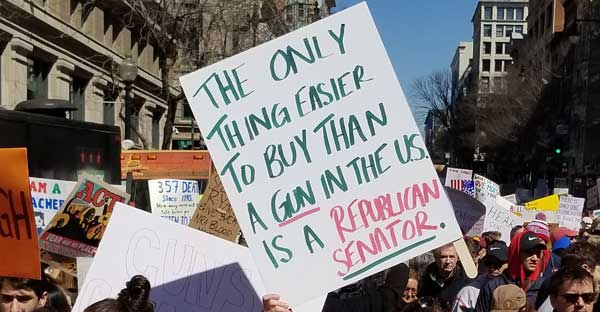
The pink hats from the 2017 Women’s March made a widespread reappearance, as did numerous anti-Trump or generally anti-Republican signs.
(Photo: Jarrett Stepman/The Daily Signal)
(Photo: Jarrett Stepman/ The Daily Signal)
The crowd was certainly not a representative slice of what the country as a whole thinks about gun control, nor did it represent the opinions of most young Americans.
As The Daily Signal recently reported, polls show that millennials are no more in favor of gun control than their parents or grandparents.
2) Well-Organized and Well-Funded
This was certainly one of the largest gatherings I’ve seen in Washington, D.C., and one of the most highly organized.
Clearly, staff from a huge number of activist pro-gun control organizations showed up, as would be expected, but there were also people on almost every street corner trying to register people to vote.
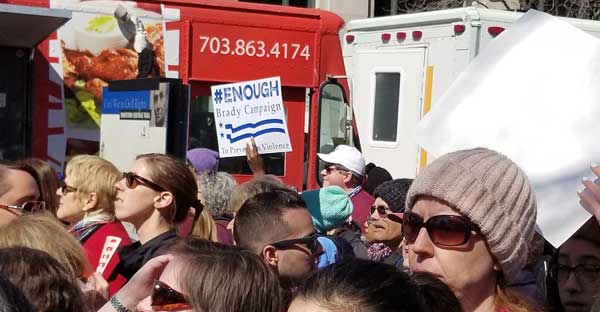
People carried signs from gun control groups, such as the Brady Campaign to Prevent Gun Violence and Moms Demand Action for Gun Sense in America.
(Photo: Jarrett Stepman/ The Daily Signal)
Undoubtedly, many people from around the country came to the protest out of a sincere belief that they were making a positive difference to end violence, but there’s also no doubt that a huge amount of professional organization and money went into this march.
A series of Hollywood celebrities funded the march, including Oprah Winfrey, George Clooney, Steven Spielberg, and others.
As BuzzFeed reported, a litany of leftist organizations and politicos got involved, including the George Soros-backed MoveOn.org, Women’s March LA, Rep. Debbie Wasserman Schultz, D-Fla., and, curiously, Planned Parenthood.
There were certainly many children present, but there’s no way they could have put this all together on their own. Outside help and organization was apparent.
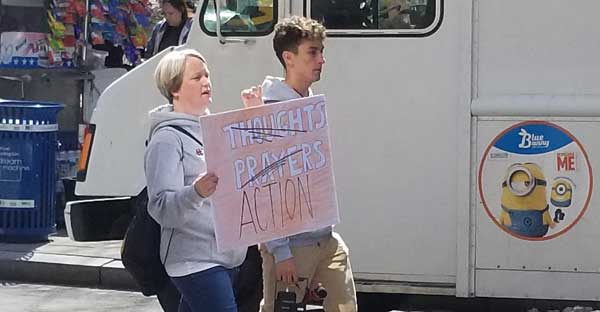
3) Prayer Is Out
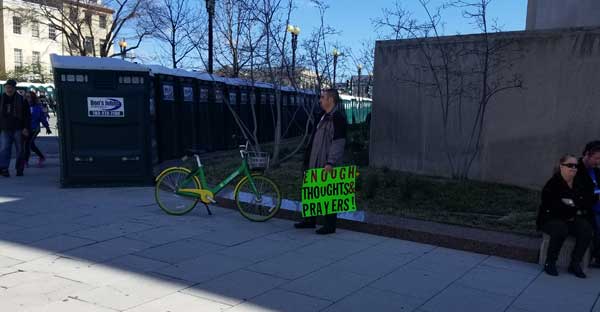
The March for Our Lives protesters were seemingly not fans of prayer.
(Photo: Jarrett Stepman/ The Daily Signal)
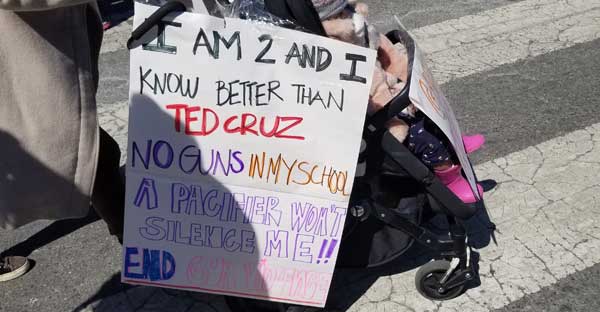
Many protesters specifically condemned the act of offering prayers in the wake of shootings, pitting it against political action. Political action is often important, but it was strange to see so many signs specifically aimed at condemning prayer.
(Photo: Jarrett Stepman/ The Daily Signal)
In the wake of the Parkland shooting, liberal calls to action have centered on banning guns. But such calls have neglected other serious issues relating to school shootings that have nothing to do with firearms, including the way America deals with the mentally ill.
Another issue is how federal and local policies have let dangerous people, like the Parkland shooter, slip through the cracks. Often the problem is not with a lack of laws, but a failure to enforce the laws that already exist.
There are a number of serious proposals that would tackle the issue of school safety without confiscating guns or seriously curtailing constitutional rights. See, for instance, The Heritage Foundation’s School Safety Initiative.
But this doesn’t fit the narrative of those leading the March for Our Lives protest, who from the outset have been committed to gun control.
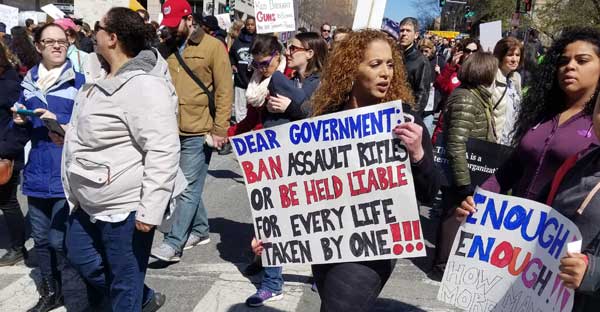
4) Those Who Disagree Viewed as Complicit in Murder
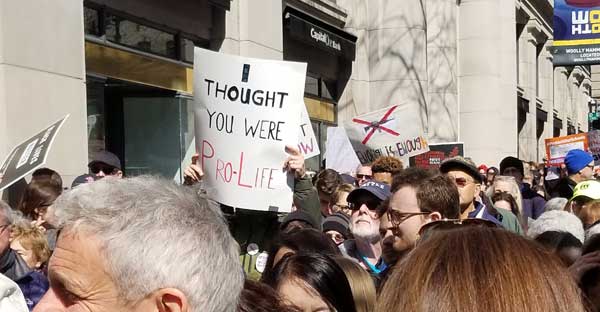
While the name March for Our Lives may be a coincidence, it certainly sounds similar to the March for Life, a pro-life rally that takes place each January in Washington, D.C.
Numerous signs claimed that those who back gun rights don’t care about the lives of children or are responsible for deaths.
(Photo: Jarrett Stepman/ The Daily Signal)
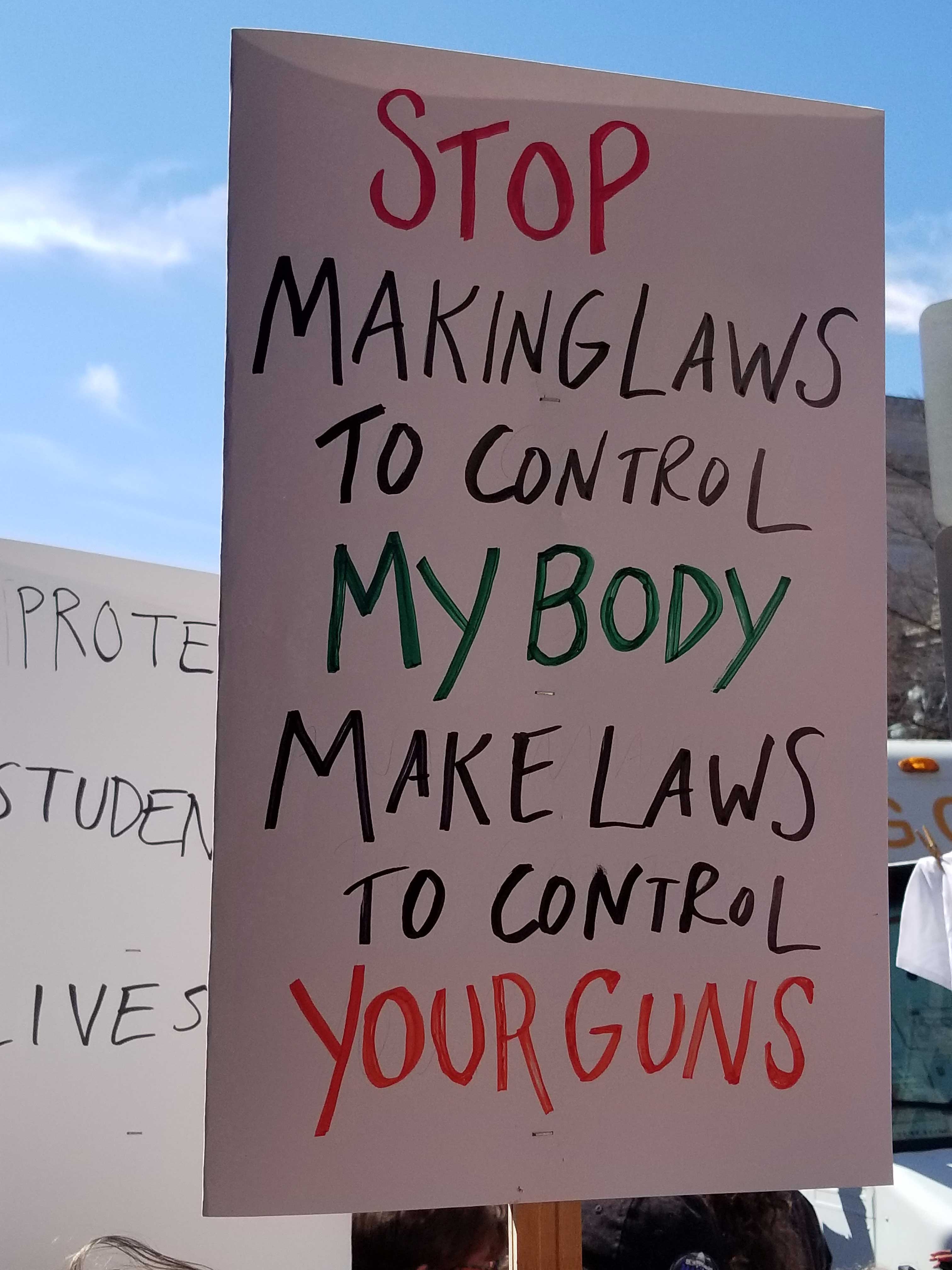
Others specifically linked the pro-abortion and gun control movements.
(Photo: Jarrett Stepman/ The Daily Signal)
And many condemned the National Rifle Association for having blood on its hands, or insinuated that the pro-gun organization has bought off politicians to support its policy interests.
One protester even compared the NRA to ISIS.
(Photo: Jarrett Stepman/ The Daily Signal)
5) Second Amendment Seen as Problematic and Outdated
While gun control advocates have generally been cautious about outright attacking the Second Amendment, many of the protesters had no such reservations.
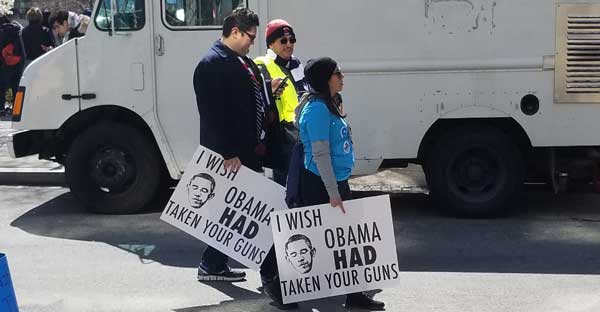
Some lamented that former President Barack Obama didn’t confiscate guns.
(Photo: Jarrett Stepman/ The Daily Signal)
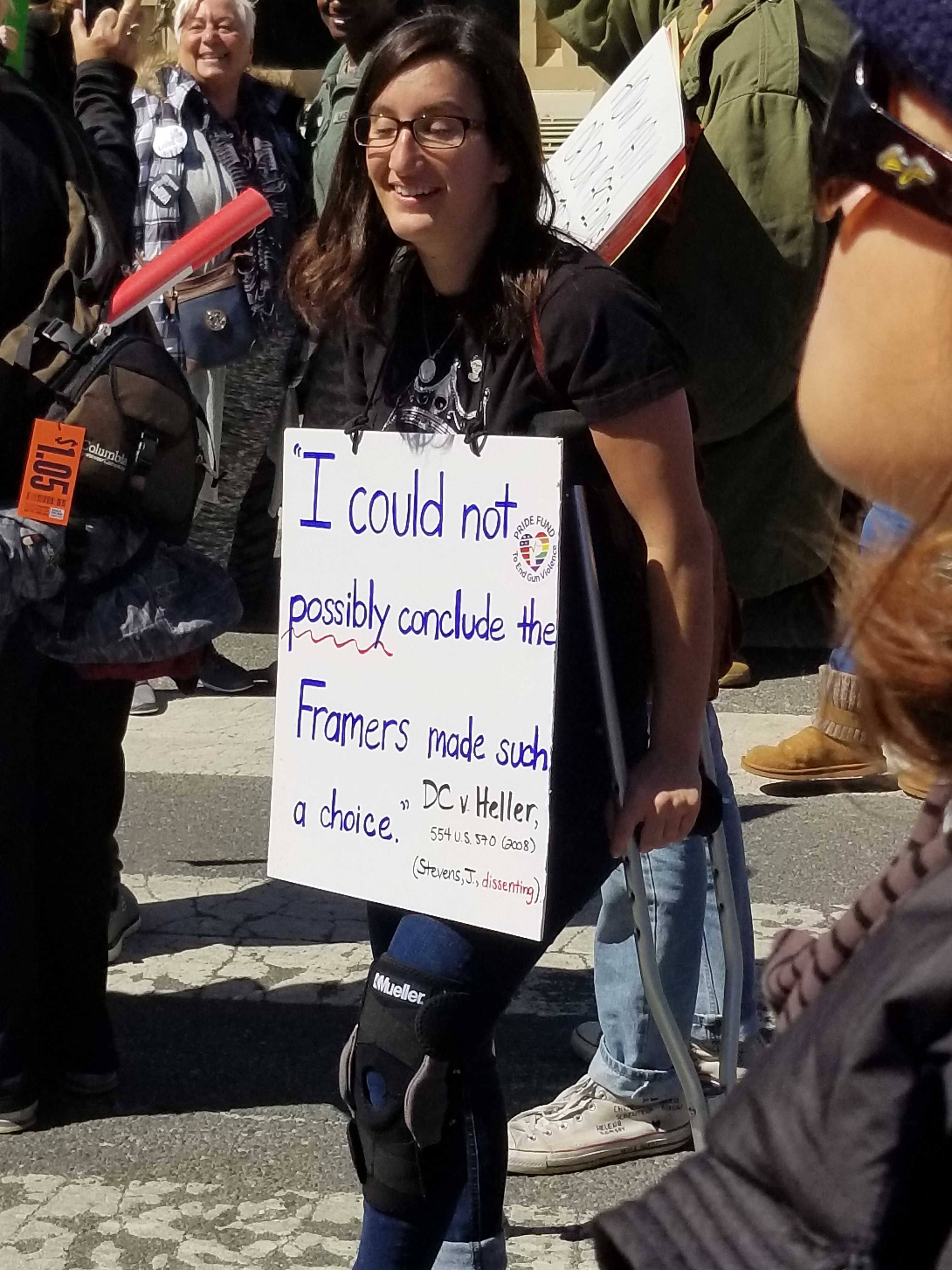
Several protesters questioned Supreme Court decisions upholding gun ownership as a constitutional right.
(Photo: Jarrett Stepman/ The Daily Signal)
Many held signs saying essentially that the Second Amendment is irrelevant because the Founders wrote it in the 18th century.
(Photo: Jarrett Stepman/ The Daily Signal)
But following that logic, one would have to question all the other provisions of the Constitution that were written by the Founding generation, including the First Amendment.
After all, the internet didn’t exist in the 18th century. Does this mean that free speech on the internet shouldn’t be protected?
And what about the constitutionally protected right to assembly, also guaranteed by the decidedly 18th-century First Amendment? These protesters seem to at least value that piece of constitutional inheritance.
6) Fuzzy Facts
It was clear that while many of the protesters were articulate in defending their views, they were misinformed about some of the facts surrounding the gun debate.
For instance, in an interview with The Daily Signal’s Genevieve Wood, one marcher repeated the thoroughly debunked claim that there had been 18 school shootings this year prior to Parkland.
This shocking number, repeated by Obama and some major media outlets, was a bogus stat cooked up by a pro-gun control group.
Almost none of the incidents used in that statistic can be described as anything like a school shooting—several were suicides or random shootings that simply took place near a school campus.
The Washington Post even called the statistic “flat wrong.”
There were other examples of misinformation as well, including one sign that called for a ban on “automatic weapons,” which have actually been bannedsince 1934.
Unfortunately, Americans have received a huge amount of disinformation about guns and gun control, much of it perpetuated by the media.
Read my piece about the six common media myths about gun control.
7) Not a Gun-Free Zone
The March for Our Lives crowd may have wanted to disarm Americans, but the event hardly took place in a gun-free zone.
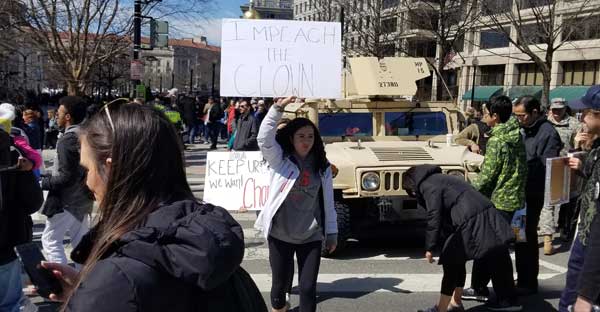
Armed police covered the streets to ensure the safety of those gathering in the nation’s capital. In fact, there were even armored military vehicles embedded within groups of protesters.
(Photo: Jarrett Stepman/ The Daily Signal)
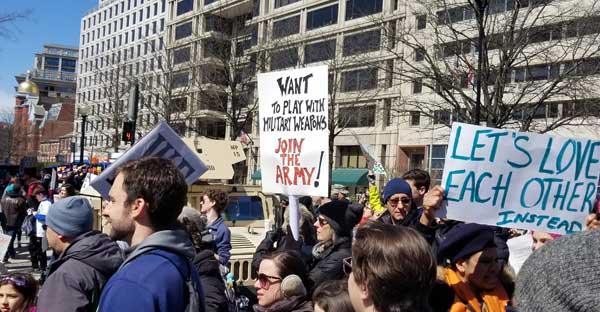
Some signs essentially called for only the government to have firearms.
(Photo: Jarrett Stepman/ The Daily Signal)
Of course, the idea that only the government and the military should have access to firearms would not have sat well with the Founders. They feared a government powerful enough to disarm the citizenry and a standing army. That’s why we have the Second Amendment.

Saturday, March 24, 2018

Things we lost after Obama left office

Race riots
3 million more on food stamps
record low labor participation
Iran harassing our ships
transgender issues dominating news
phone climate change stuff dominating our news
Israel being bullied
IRS abusing Obama's opponents
Giving guns to Mexican drug lords
Ignoring Hezbollah drug business
Russia expanding beyond Ukraine
Black lives matter dominating news

notice how Iran stopped harassing our ships once trump took over

Iran's navy made a point of harassing and humiliating the US Navy in 2016 after then-President Barack Obama had sealed the Iran deal, but under President Donald Trump, they have stopped. The US Navy openly acknowledges the shift in tactics from Iran, which an expert told Business Insider was based on Trump's unpredictability and credibility with regard to military strikes.